by Sam Tackeff | Aug 24, 2009 | Books, Ice Cream

I have the most marvelous news to share:
David Lebovitz is coming to visit us at Omnivore Books in San Francisco from 6-7 pm on September 28th. This is possibly the greatest thing that could ever happen, because, well, it’s David Lebovitz! DAVID LEBOVITZ!!!!!
I’ve been gushing about it since Celia found out! And I nearly died when he became friends with the bookstore on Twitter.
If you don’t know who he is well, in quick summation – he’s a most amazing man who used to live in San Francisco and do pastry at Chez Panisse under Lindsey Shere, until he decided to take his chances on living a fabulous life in one of the most beautiful and dare I say delicious cities in the world – Paris.
And he blogs about it, and he tweets about it, and he captures the idiosyncrasies of the French quite perfectly in his new book: The Sweet Life in Paris: Delicious Adventures in the World’s Most Glorious – and Perplexing – City. It made me giggle the entire way through. And then I went to the store tout de suite to recreate the well chosen recipes in each chapter.
Ever since I got my new Kitchenaid Icecream Maker attachment last month (THANK YOU MOM!), I’ve been working through David’s recipes from his book “The Perfect Scoop”.
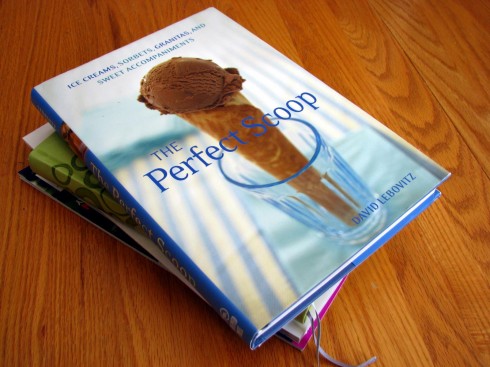
His recipe for nectarine sorbet has been a favorite, because we have been blessed with delicious crops of nectarines and peaches here in California – so I’ve made this twice now. I used really, really ripe fruit – almost on the verge of turning, and the final products were so painfully delicious.
I’m posting the recipe verbatim (something I never do), only because it’s really quite perfect, and I think it captures his personality quite well. (My only notes are – that I skipped the skinning step when making peach sorbet, and it still worked out just fine – also, do make sure to put the kirsch or lemon juice, because it helps to form a smoother sorbet and avoid ice crystallization).
Nectarine Sorbet
makes about 1 quart (1 liter)
There’s a curious custom in Gascony, a region in the southwest of France known for its full-bodied red wines (it’s famous neighbor is Bordeaux). When they’ve just about finished their soup, the locals tip a little bit of the red wine from their glass into their soup bowl, mingling the wine with the last few spoonfuls of the broth.
I later discovered that this custom is equally good with a goblet of sorbet when I was scrambling to figure out a way to make this rosy nectarine sorbet a bit more special for an impromptu dinner party. I simply scooped sorbet into my guests’ wine glasses at the table and let them pour in as little (or as much) red wine as they wished. It was a big success. If you have time to think ahead, prepare a big bowl of sweet, juicy berries and sliced nectarines, and let your guests add some fruit to their sorbet too.
6 ripe nectarines (about 2 pounds, 1kg)
2/3 cup (160 ml) water
1/4 cup (150 g) sugar
1 teaspoon kirsch, or 1/4 teaspoon freshly squeezed lemon juice
Slice the nectarines in half and remove the pits. Cut the unpeeled nectarines into small chunks and cook them with the water in a medium, nonreactive saucepan, covered, over medium heat, stirring occasionally, until they’re soft and cooked through, about 10 minutes. Add a bit more water if necessary during cooking.
Remove from the heat and stir in the sugar. Let cool to room temperature. When cool, puree the mixture in a blender or food processor, until smooth. Stir in the kirsch or lemon juice.
Chill thoroughly, then freeze it in your ice cream maker according to the manufacturer’s instructions.
Variation: For Peach Sorbet, substitute 7 large, ripe peaches for the nectarines. Remove the skins prior to cutting them into chunks.
Perfect Pairings: If you like the idea of red wine with Nectarine Sorbet, pair it with the Raspberry-Rose Sorbet (page 130), or simply serve it in goblets and pass a bottle of fruity red wine, such as Beaujolais, Brouilly, or Merlot.
by Sam Tackeff | Aug 9, 2009 | Farmers Market, Local stores, Shopping, Vegetables
It’s something terrible we have all experienced. Accidentally eating a light pink, mealy, and flavorless tomato. Or perhaps eating a bland, completely tasteless melon. Or worse eating slices from an unripe slightly green banana. How do you ensure that you are eating the tastiest and most nutrient rich fruits and vegetables? Start eating seasonally and locally!
Eating seasonally means eating whats ripe when it reaches its natural point of the seasonal growing cycle. Heading to your local farmer’s market or green market is a good way to start, a level up would be joining a local farm’s CSA to get yourself fresh fruits and vegetables ever week or two through the summer, and even in winter. Here are my favorite go to resources:
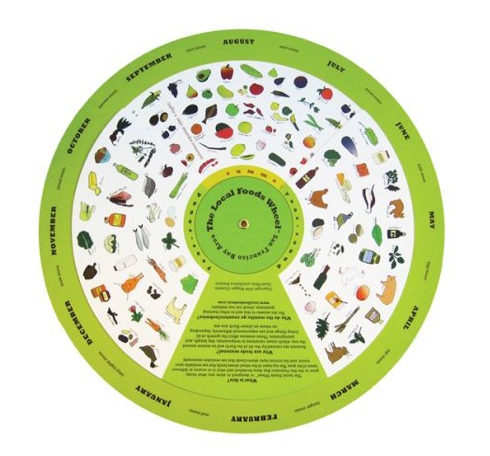
For the Fridge: Because I live in San Francisco, I’m blessed to be able to use the Local Foods Wheel which shows both foods that are in season all year round on the inner circle, and foods coming into season on the outer circle. So far there is a New York version and a San Francisco version – let’s hope they expand soon! (If you are in SF – you can pick up your own copy at Omnivore Books! We have ’em in stock)
Portable for the tech crowd: the Seasons iPhone application will give you seasons information for “fruits, vegetables, lettuces, herbs, fungi and nuts,” for wherever you happen to be. You can view local seasons versus import seasons and see a graph that shows how “in season” a given food is. It’s $1.99, but you can take it everywhere!
There are also a few websites that are great resources: the Northeast Regional Food Guide for the New England area, and in Europe, BBC Food runs the What’s In Season page . A little more obscurely, a Swiss couple runs a site called Laughing Lemon, that also shows what is in season each month, and points out some rarer vegetables and fruits. Because the northern hemisphere has similar growing zones, these sites can be helpful for anyone in that general region. (via Maki)
For further reading, there are several cookbooks that discuss eating seasonally that I love:
– Jamie Oliver’s Jamie at Home (discusses growing and cooking methods for seasonal veg)
– Nigel Slater’s Kitchen Diaries (his eating journal for a year of dinners)
– River Cottage Vegetable Handbook – the River Cottage makes the best little handbooks on the planet. They have ones for mushrooms, preserving, bread making, and seafood as well.
Do you go to your local farmers market? Are you a member of a CSA? (Actually, if you are a member of a CSA that you love in San Francisco, gush about it here in the comments. I need suggestions! )
by Sam Tackeff | Aug 6, 2009 | Ingredients, Italian, Pantry Staples, Quick and Easy
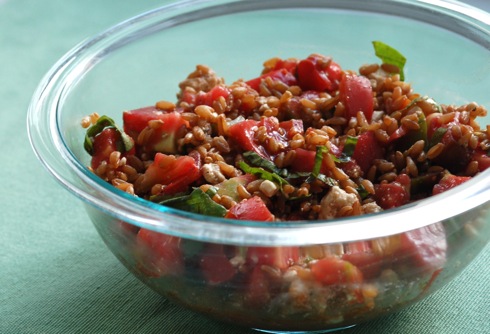
Farro is an interesting grain with a nice bite, that is well suited to easy summer salads. I use it in recipes that call for wheatberries, green lentils, bulgur or even barley occasionally as a replacement, but I find that I love it best in this salad with tomato, basil, feta, and a balsamic vinaigrette. I’m lucky to find farro at Rainbow Foods in San Francisco, but in some places, farro can be pricey – try shopping for it in stores with bulk bins, at trader joe’s, or even online.
Farro is an Italian word, and when I eat this grain, I find myself transported to Tuscany, sitting in the garden of my imaginary apartment, eating blissfully, drinking a glass of wine, and contemplating nothing but relaxation.
As usual, I use Mark Bittman’s pretty foolproof way of cooking most grains – put one cup of the grain in a small pot, and cover by at least an inch of liquid – bring to a boil, and turn down, cover, and simmer for 30-35 minutes without touching it. Then you can test it – if it’s not done, just add a few more tablespoons of liquid, and leave on the heat for ten more minutes. Unlike rice, don’t worry if there is extra liquid after the cooking time, just drain it.
MASTER RECIPE! Variations: This salad is also a great vehicle for crunchy vegetables – feel free to add fresh corn kernels (you don’t need to cook them!), black beans, bits of chopped red pepper, cucumber, shavings of carrot, chick peas, or even little cubes of summer squash to name just a few! Also, you can punch up the herbs with some fresh parsley or fresh mint (or both) to give it some extra green. No balsamic on hand? Just make a simple lemon vinaigrette with the same proportions of lemon to olive oil.
Farro Salad with Tomatoes, Basil, and Feta
serves 2 as a main, 4 as a side
Ingredients:
– 1 cup farro
– enough salted water or chicken broth to cover farro by one inch in pot (about 2.5 cups)
– 1 large heirloom tomato, chopped (ripe! uglier the better!)
– about ten leaves of basil, rolled into a cigar shape and chopped
– salt and pepper
– 2 ounces feta cheese
– 2 tablespoons balsamic vinegar
– 4 tablespoons extra virgin olive oil
Method:
1. In a medium saucepan, combine the farro and enough water (or chicken stock) to cover farro by an inch. Bring to a boil over high heat. Reduce the heat to medium-low, cover, and simmer until the farro is tender, about 35 minutes. Drain, and set aside.
2. In a large bowl, add the chopped tomatoes, basil, and feta, and cover with the slightly cooled farro. In a small bowl, whisk together the balsamic vinegar, salt, pepper, and olive oil to make a vinaigrette. Pour into the farro salad, and toss to coat. You can eat this warm, or it can be made in advance and popped in the refrigerator. Just let it come back to room temperature when you want to eat it, and make sure to re-toss it!
by Sam Tackeff | Jul 30, 2009 | Random

Mashable just posted their 15 top social media resources for foodies and I thought I’d weigh in on the subject. Some of them are crossover – that probably just means that they are really the best.
Note: I think that the best resources are often looking at the links pages and blogrolls of your favorite food bloggers. When I’m not exploring new sites that I find through the blogs, these are my go to resources:
Food bloggers:
*Foodbuzz : This is one of the best and fastest growing food sites on the web which brings together food bloggers from all over the world, and hosts the most excellent 24,24,24 every month, where 24 food bloggers from all over the globe are generously provided a hefty sum to enjoy their dream meals. Foodbuzz also works with sponsors to provide food lovers with a tastemakers program that has great perks of free food that comes to you in the mail. I’m looking forward to their food bloggers conference in San Francisco in the fall – keep an eye out for it! – and I’m a very happy participant (they aren’t paying me to say this!) and am excited to see what they have planned in the next few months to come.
*Alltop : You can use Alltop to catch up on the recent posts of the best of the best food blogs all in one place. Alltop is a web aggregator that allows you to keep up on your favorite topics. I also check out other aggregators such as StumbleUpon and Digg regularly to find new food related sites and keep up with food news.
*Epicurious: This website hosts recipes from several of the Conde Nast magazines including Bon Appetit and Gourmet. I use this, the Food Network, and Martha Stewart for the majority of my basic recipe searches.
*Goodbites: A collective efforts from some of the top food bloggers to create a network of recipes and food videos sure to please and entertain! Organizers include Jaden from Steamy Kitchen, David Lebovitz, and Deb from Smitten Kitchen just to name a few!
*Tasty Kitchen: The Pioneer Woman’s newest project – a networking site for recipes organized by Ree Drummond, one of the queens of blogging.
Restaurant Reviews/ Food Chatter
*Zagat was the original guide to good eats in cities across the country, and I’m always sure to get their city guide whenever I’m moving to a new place or exporing a new city. They have a good website now, but some of the features require a membership to access them. I think it’s worth it.
*Yelp – Yelp is my go to for plotting out my neigborhood – sometimes you have to take the reviews with a grain of salt, but it’s the first spot for figuring out where to go to dinner on any particular evening. Other similar sites include UrbanSpoon and Chow which both feature restaurant reviews. Chow also is a growing food community and hosts a great deal of food conversations and chatter as well. And don’t forget to make restaurant reseverations on OpenTable!
*Chefsblade: Chefsblade is a new community website for chefs, food lovers and anyone interested in the food business in general. They also post great articles about food and food trends, and are a growing social networking site for the industry and those intrigued by it.
Food Porn
*Tastespotting and Foodgawker: Two sites which aggregate beautiful photos from hundreds of different food blogs – it’s really what I’d have to call foodporn – I could click through these sites all day long.
What are your favorite food sites? Anything fantastic that I’m missing out on?
“Apple Pie” image via EvilMadScientist
by Sam Tackeff | Jul 24, 2009 | Mexican, Pantry Staples, Soups
I’ve been working all week long in the bookstore (Omnivore Books on Food), while Celia, the owner is away in Paris (so jealous!), and find myself spending the entire day pouring through cookbooks and food memoirs, only to find myself hungry and a little exhausted by the time I get home for dinner.
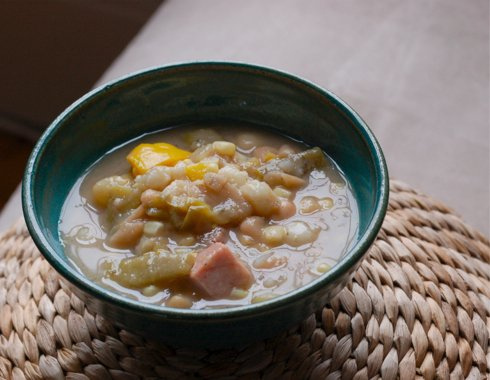
While I don’t subscribe to the 30 minute meal mentality, I am enamored by recipes that take no more than 15 minutes to put together, and then cook on the stove for an hour or more with little to no fuss – enough time for really rich flavors to develop, and delicious aromas to perfume the house. I’ve been on a bit of a Mexican kick for the past few weeks, reading through our selection here in the shop, and came up with this Pozole – drawn from many sources and adapted for my own kitchen.
This is one of those great recipes where you need a big pot and a cutting board and really nothing else. It’s really a pantry recipe, and it’s basis is the hominy, which is made from maize but almost has the consistency of potato. Add the growers trinity (three sisters): beans, corn, and squash, and you have a delicious stew. They say what grows together goes together, and its certainly evident in this dish.
I get this started the moment I walk in the door, and then have a good amount of time to wind down, organize myself, read my email, and check in with my friends and family before dinner.
An Easy Pozole
serves 4
Ingredients
– 1 29 oz can white hominy
– 1 15 oz can white kidney beans (cannellini beans)
– A corn cob, kernels stripped, cob in the pot as well
– a 1/2 pound of green beans or romano beans, cut into 1 inch strips
– 4 or 5 pattypan squash, cubed
– Ham steak, cubed (the 1 inch thick prepackaged variety works fine)
– 1 onion, chopped
– 2 garlic cloves, smushed with your hand, or the flat of a heavy knife
– 1/2 teaspoon of dry marjoram (or a large sprig of fresh)
– 1/2 teaspoon dry oregano (or a large sprig of fresh)
– a teaspoon of chopped chile (or red pepper flakes)
– 3/4-1 Tbs. Cumin
– salt and pepper to season
Method
Add everything to a big pot, cover with water, to about an inch over everything, gently bring to a boil on medium high heat, and then turn heat down to medium low, cover loosely leaving the lid just a tiny bit ajar, and simmer an hour or more, stirring every once in a while, until you are too hungry to wait any longer. Take out the corn cob, and serve.
Serve with Lime and Cilantro, for garnish, and some warm tortillas for dipping.
Variations: Consider this a recipe that you can easily adjust based on what you have in the kitchen or on hand. I’d keep the onion and spices the same, but feel free to vary the amount of squash (any type of summer squash would do), and the types of beans, etc. You can pop in more vegetables if you’d like, such as chopped red pepper, tomato, or even leafy greens. You can also kick up the heat by adding more pepper – it’s really good hot!