Lamb Pro-Am: Lamb Mechoui + Moroccan Marinated Carrots
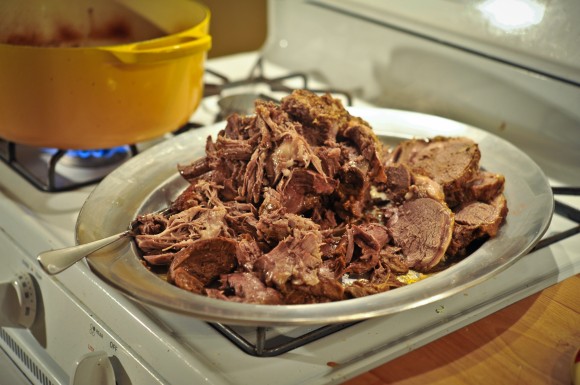
Editor’s note: thank you so much to everyone who voted for me in the competition! This was not only the winning recipe, but the winning competition dish. What a blast!
Last week I ran out of my office in Haymarket, laden with my massive computer bag, and wearing flats, managed to sprint over to Tavern Road, a little over a mile, in 14 minutes. For a lamb party.
Tavern Road is the newest restaurant to pop up on Congress Street in Fort Point, and I’ve loved what I’ve seen (and tasted) so far. The restaurant is modern American, with as much attention paid to vegetables as to charcuterie. Last week I stopped by for a little pre-dinner, where I made my way through three vegetable dishes and a few slices of ham. The one that stood out was the grilled broccoli rabe with vanilla and hazelnuts, but everything was very good. They also have a well worn selection of cookbooks on the open kitchen counter, including Bertolli’s ‘Cooking by Hand’, which always leads me to judge a cook favorably. I’ll be stopping by often, so I’ll be sure to report back soon. {The only warning I have is that most of the parking turns into residential past 6pm. I learned this not because of the signs, but because of the 40 dollar parking ticket I earned last week for moving my car two blocks over from the lot to near the restaurant… yeesh.}
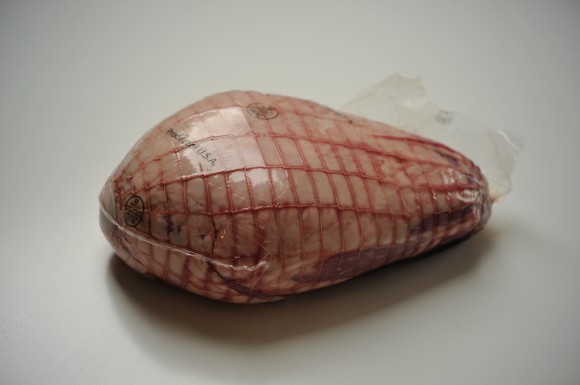
So about this party – the kind folks at BostonChefs.com invited me to participate in the American Lamb Board Lamb Pro-Am – a promotional event hooking up bloggers with local chefs to celebrate the most delicious of meats. (Seriously, I love it more than bacon.) At the party, we were served lamb meatballs, and provided with lamb swag, and a *massive* boneless leg of lamb to have our way with (and come up with a recipe for the competition).
I don’t usually participate in contests – let’s face it, they usually end up being a popularity thing – but I couldn’t turn down all this meaty goodness (especially in the midst of my gym challenge!). So here’s the deal – voting will begin on 4/17, and if you like lamb, and the possibility of hooking me up with a local chef to make you delicious noms, ewe should vote for me! {UPDATE: Please VOTE for me here: http://bit.ly/ProAm2013 !! Click on that Lamb Mechoui + Moroccan Marinated Carrots on the right, and help me be victorious! Voting will end next Friday, 4/26 at 5pm}
If you, like me, missed out on the Lamb Jam last month (everyone who went managed to make me jealous and bitter), never fear, the winners will be cooking up food for the masses at the official Lamb Pro-Am event on May 19th. If you’d like to gorge yourselves on the winning dishes, Pro-Am ticket sales have begun! Here’s a link to the event page: http://bit.ly/ProAm2013 and here’s a link to the ticket sales page: http://bit.ly/ProAmTix
Without further ado, let me wax poetic about lamb. It’s a little long, forgive me. If you get bored, just scroll though the photos – I did my best to make them lamb-tastic.
I think I’ve mentioned it often enough, but if you are new here, much of my culinary background comes from my Jewish and Turkish heritage, with a smattering of influence from French, Greek, and Moroccan relatives. I’ve grown up in a family who loves to cook, and who more importantly loves to eat – and so I’ve done a lot of it, all over the world, with dedication and gusto.
In my kitchen, Middle Eastern and North African flavors are the most prevalent. I love the rich, warm, sometimes smoky spices. I like spices that pack a punch – I cook with fistfuls of fresh herbs, particularly parsley and mint, and I use a lot of citrus.
Turks eat a lot of lamb – for centuries it has been the most popular type of meat, and pops up in hundreds of different dishes. You’ll commonly find it made into kebabs, pilafs, köfte (meatballs), and stews. Ground lamb is mixed with rice and stuffed into grape leaves, called dolma. It is roasted on spits, and strewn onto little flatbreads called lahmacun, or stuffed in tiny dumplings called mantı, topped with yogurt sauce. I’ve probably eaten a small herd’s worth in my lifetime.
For this recipe, I opted to draw from the flavors and techniques of Moroccan cooking, which feel deeply rooted in my hands and heart, despite never having been on Moroccan soil. (My uncle, however, grew up in Tangiers, so I’ve been gleefully eating Moroccan food since childhood.)
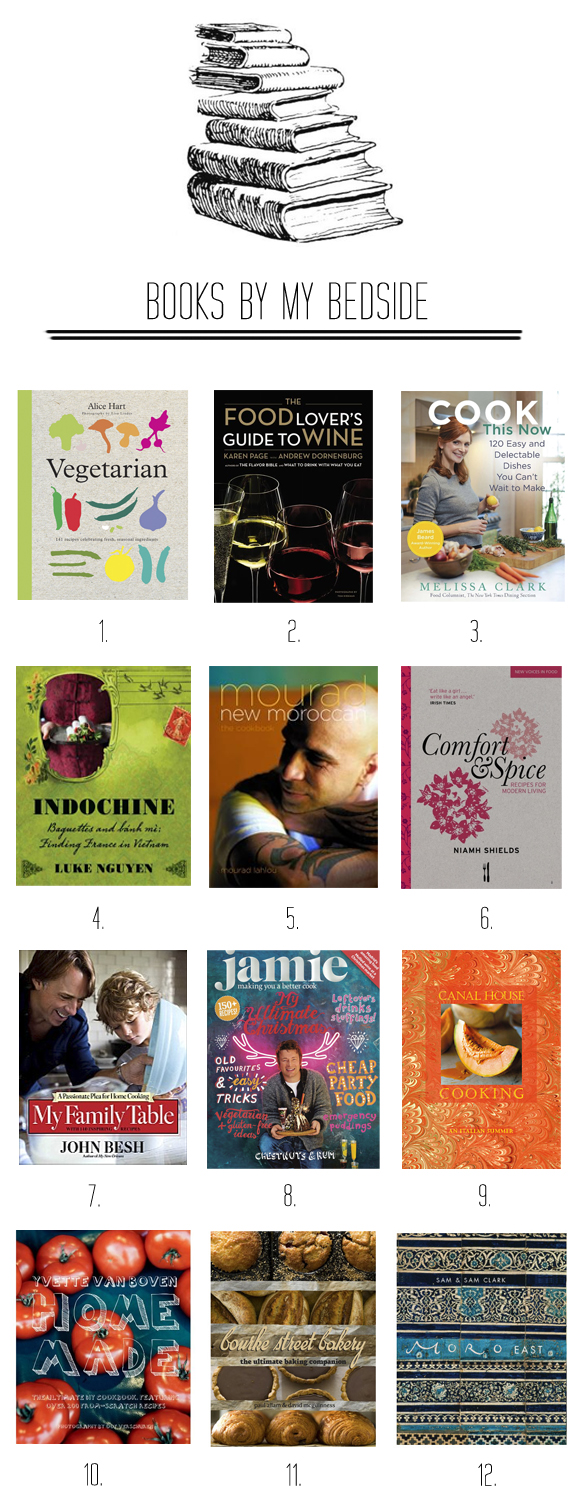
I decided to take a stab at Lamb Mechoui, a slow cooked lamb that is either cooked on a spit, or steamed, until it is falling apart tender, and can be pulled (like southern barbecue) with a fork. I flicked through a dozen cookbooks on my shelf for inspiration – I have a large collection of Middle Eastern, Moroccan, and Mediterranean cookbooks, fantastic titles by Claudia Roden, Paula Wolfert, Joyce Goldstein, Sam & Sam Clark, and Mourad Lahlou to name a few. I settled on the lamb and carrot salad combination from Jamie Oliver’s ‘Jamie Does‘, and decided to punch up the saffron and opt for a steaming/braising method at the suggestion of Mourad Lahlou’s ‘New Moroccan’.
Lamb Mechoui is typically a large cut of lamb such as a leg or a shoulder, smothered in smen (a type of fermented, aged butter), and coated liberally with spices. It’s not impossible to find smen around here (I’ve seen it at Russo’s), but it is expensive.
Joyce Goldstein mentions in ‘Saffron Shores: Jewish Cooking of the Southern Mediterranean’ that the Jews actually made a version of Mechoui, although it certainly wouldn’t have had any butter, as Jews don’t mix milk and meat.
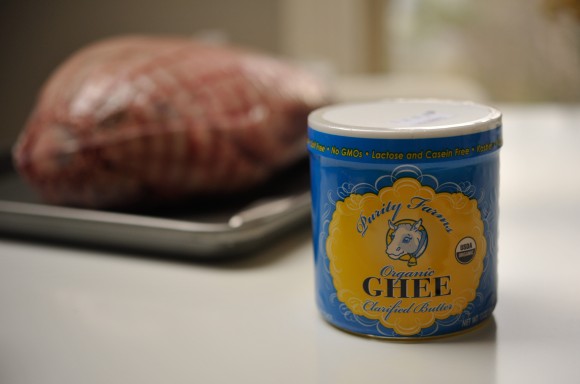
For this recipe, I decided to use Ghee – clarified butter which has been removed of dairy solids. Ghee is sweeter than smen, but plays well with the spices, and I cook with it often. It’s also Paleo friendly and Whole 30 approved, if that matters to you! I’ve made my own with Kerrygold Butter, but was in a pinch this weekend, so picked up a large jar from Purity Farms.
I usually keep ghee at room temperature, but I softened it for a few seconds in the microwave so I could work the spices into it easily. The first step was to work in the salt and the saffron.
You don’t have to make this with saffron, but it lends a lovely unique flavor. When my mom went to Istanbul this summer, I asked her to bring me back kilos of spices from the spice bazaar, including a good amount of saffron threads. These come from Turkey, but I also have a stash from Spain. There’s always a big controversy over the legitimacy of saffron, but as far as I can tell, these both are as real as you can get. A small amount of saffron goes a long way!
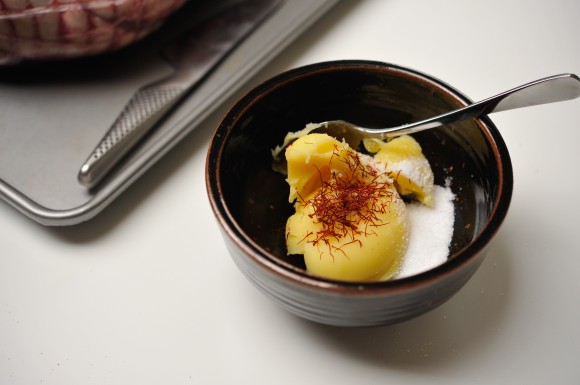
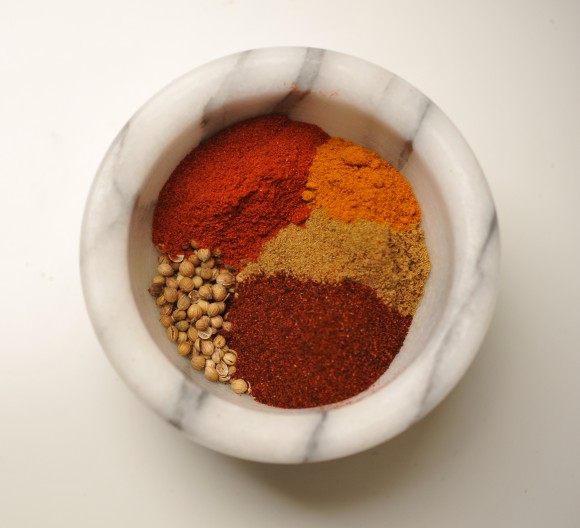
The rest of the spices I added were coriander (typically I use ground, but I had run out, and it’s always easy to bash some in the mortar and pestle), cumin, chile powder (I get mine from Rancho Gordo), paprika, and turmeric.
Before spreading on the paste, I stabbed the lamb a dozen times, and stuffed the holes with sliced cloves of garlic. Then, I did my best to coat both sides with the spice mixture.
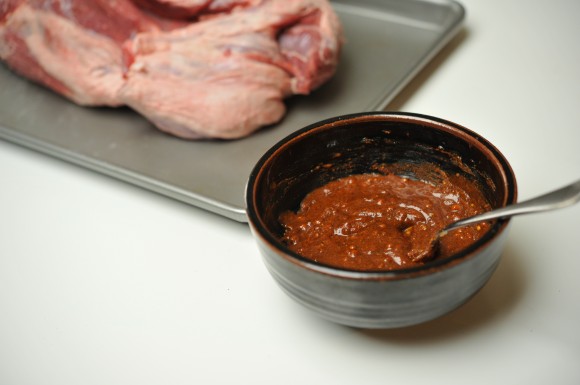
After coating the lamb, I let it sit at room temperature for two hours, to let the flavors permeate, and to ensure that the large piece of meat was fully at room temperature to help it cook evenly. I then transferred it to my large Le Creuset dutch oven, added a half cup or so of water, covered the pot with the heavy lid, and popped it in a 350 degree oven.
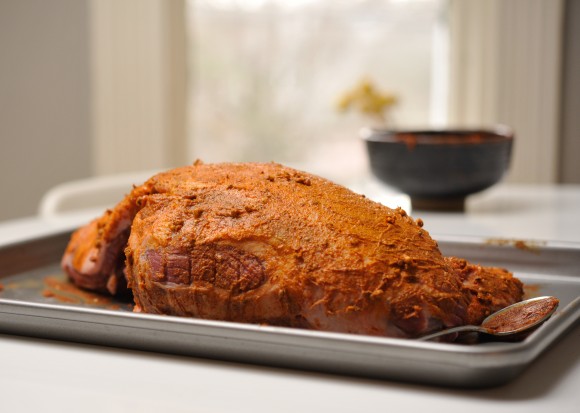
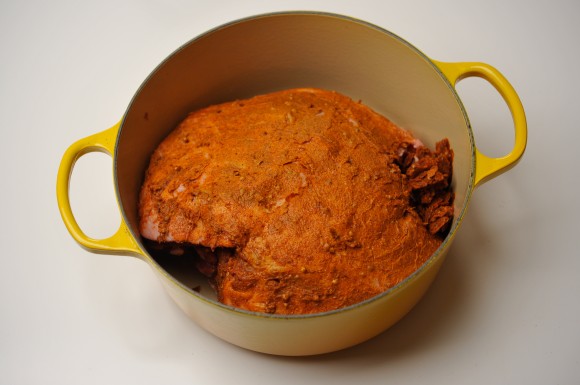
While in the oven, it requires a little attention – basting every 30-45 minutes with a turkey baster. I let it cook for just under three hours, then uncovered the pot, and let the skin crisp up a little bit for about 30 minutes. Then I took the lamb out to rest, put the pot on the stove top, and cooked down the juices into a thick, lamb-y sauce.
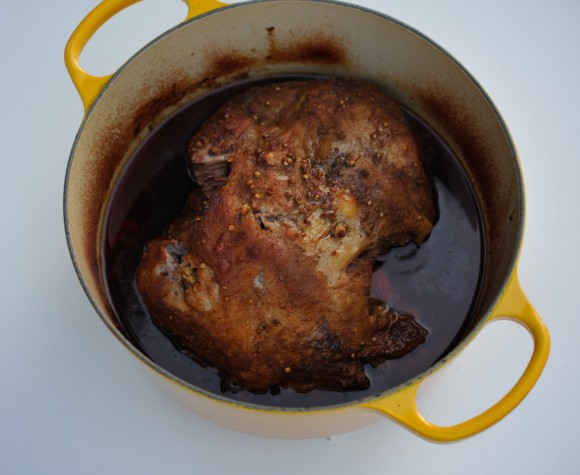
The final result was moist, tender, and exceedingly delicious. For an authentic eating experience, you might just ladle a bowl full of sauce, and dip pieces of lamb first in the sauce, then in some cumin and salt. I decided to have some balanced vegetables, and made some carrot salad to accompany it – the recipe is below!
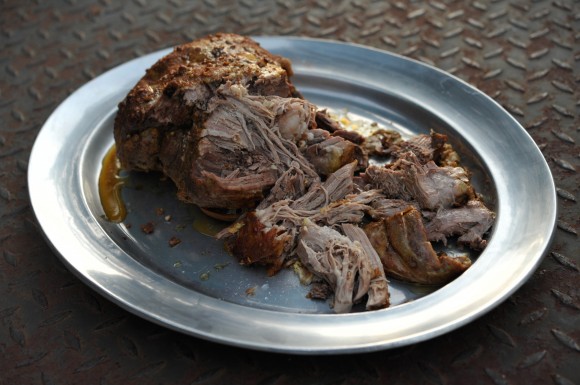
Lamb Mechoui
The boneless leg of lamb from the American Lamb Board was a hefty 8 pounds, but this recipe is scaled down to a four to five pound roast.
1 leg of lamb (or shoulder)
4-5 cloves of garlic, sliced
50 grams of smen or ghee (about 1/2 stick of butter), at room temperature
1/2 teaspoon of saffron threads
1 Tablespoon kosher salt
1 Tablespoon ground coriander
1 Tablespoon ground cumin
2 teaspoons chile powder
1 teaspoon sweet paprika
1/4 teaspoon turmeric
Take the lamb out of the refrigerator, and cut slits in the lamb. Slice the cloves of garlic, and insert into slits.
In a small bowl, mix softened ghee (or smen or butter) with threads of saffron and salt. Then add cumin, coriander, chile powder, paprika, and turmeric, and stir into a paste. Liberally rub the lamb on the inside and out with the mixture, and let rest for an hour or two at room temperature.
Preheat the oven to 350 degrees for half an hour. Place the lamb in a large dutch oven, skin side up. Pour about half a cup of water into the bottom of the pot, cover, and place into the hot oven. You can also make this in a deep roasting pan, being sure to cover tightly with a double layer of foil. Cook for about 3 hours, basting every 30 – 45 minutes. (It could take shorter or longer depending on the size of your roast.) The meat should be tender, and pull apart with a fork. For the last half hour, remove the lid, and let the skin crisp up.
Transfer the lamb to a platter, and let rest for 10 minutes, before shredding with a fork. While the meat is resting, put the pot with all the juices on the stove, and bring to a low boil, reducing for 10-15 minutes until the liquid is concentrated. Serve the shredded lamb with the lamb reduction, wedges of lemon, and salad accompaniments. (A little bit of yogurt, drizzled with a little bit of olive oil, topped with a few pomegranate seeds is nice here.)
* * *
This lamb dish is quite rich, and needs a tart salad to brighten things up. For our feast, I put together Moroccan Marinated Carrots – my favorite go to salad.
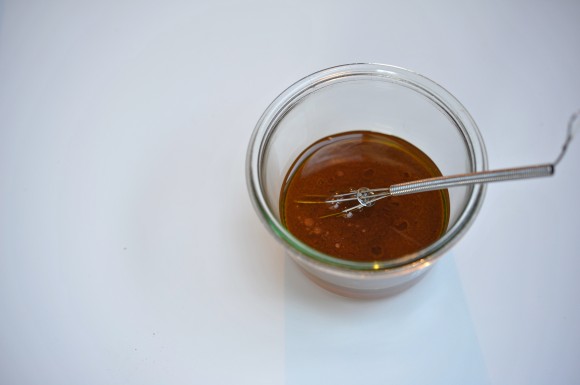
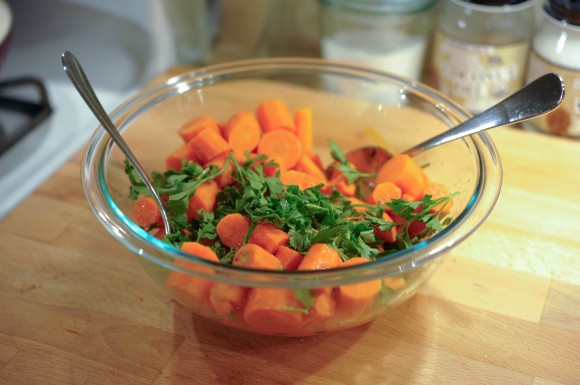
Moroccan Marinated Carrots
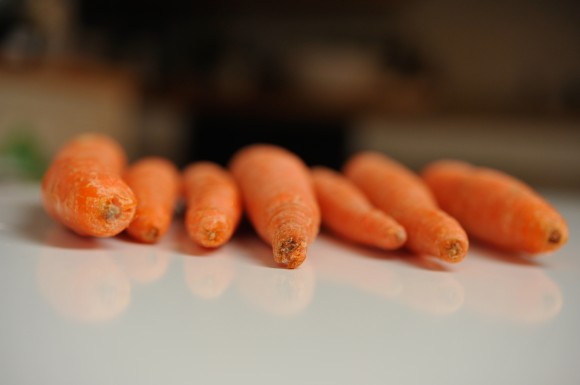
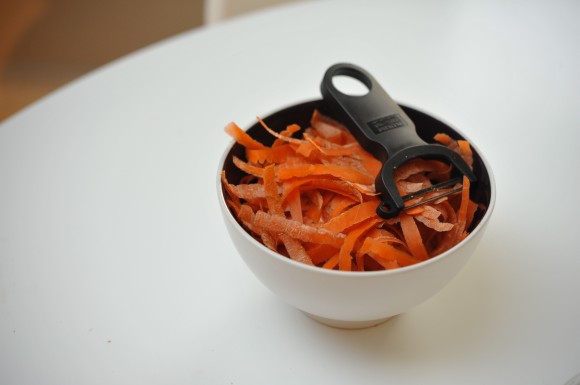
I make a version of this salad on a regular basis, sometimes substituting roasted, or even raw shredded carrots for the steamed ones I’ve used here. The garlic powder is untraditional (and possibly tacky), but it dissolves well in the dressing. Sometimes, I add a little bit of runny honey to bring out the sweetness. It’s a bright, spiced side, that goes well with all types of roasted and grilled meats. Or, you could add chickpeas and toasted almonds, for a vegetarian meal. A fistful of mint is also a nice addition.1 pound carrots, peeled and cut on the bias into thick rounds.
1 clove garlic
1 tablespoon ground cumin
1/2 teaspoon ground coriander
1/2 teaspoon paprika
1/2 teaspoon garlic powder
1/2 teaspoon cayenne pepper
a few large pinches kosher salt
juice of a lemon
olive oil
a large handful chopped parsley
In a large pot of boil in boiling, salted water, add the carrots and garlic, and boil 6-8 minutes until soft. Drain. (Or, steam carrots in the microwave for 5 minutes with a little bit of water.)
In a small bowl, add cumin, coriander, paprika, cayenne, salt and lemon juice. Whisk together, and slowly pour in olive oil, whisking to combine. Pour over warm carrots, and then let marinate – at least half an hour, or overnight in the fridge. Lasts quite well for three to four days, although I usually add a new handful of fresh herbs to perk things up.
* * *
Please vote for me here: http://bit.ly/ProAm2013 (Voting will end next Friday, 4/26 at 5pm)