by Sam Tackeff | Nov 14, 2011 | Baking, Cookies
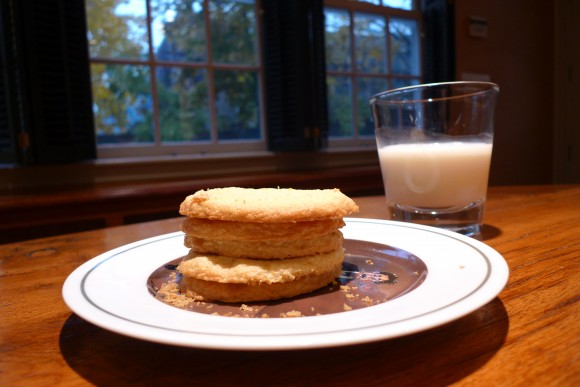
Life Philosophy #734: If not for yourself, bake for others.
I haven’t been baking enough. It’s been a strained relationship with my oven, and the poor appliance has been complaining of neglect.
And worse, I’ve been denying myself of something I really enjoy. I love mixing and stirring and folding and spreading batter in a tin. I love that you can’t tinker forever with your baking – you do the work, pop it in the oven, and then you are done and you must pray and wait.
The real problem is that when I bake, I eat. Ah, but moderation, you say! It’s as simple as moderation! Well, frankly, I’m not very good at moderation. When I bake, I eat and eat and eat, until I’ve finished the entire batch of cookies over a period of an afternoon. Sometimes, I’ll alternate cookies with bites of cheddar to get that elusive sweet and salty combination. Or I rationalize bundt cake for both breakfast and afternoon snack. When I bake, the line between treat and meal becomes blurred, and terrible things happen.
At some point in the past several years, I gave up my love of baking to pursue more health conscious pursuits. Now, instead of cookies, my oven is used for braising or heating up a single frozen biscuit, or maybe some Trader Joe’s Naan. On good days, I may bake an apple and at least get the satisfaction of the smell of warming cinnamon. This restriction has been good for keeping myself on the right track (calorically speaking), but I’ve suffered emotionally. I miss the calming effect of baking, the sweet smells in the kitchen, and the satisfaction when things turn out right.
So with holidays around the corner, and the potential for winter doldrums, I’m going to be back peeking in at rising cookies, cakes, and breads. And I’m just going to give most of what I bake away. If you are a committed eater, let me know, and we can work something out.
I think my plan has been working out pretty splendidly. Last week I made Pumpkin Chocolate Chip Cake. It’s my absolute favorite recipe in the world. I divided the batch into two loaves, and sent one to my brother who is a sophomore at George Mason, the other I brought to Devon’s office in a sort of stealth cake-drop that made people really happy. (I snuck in and left the cake on his desk when they were out of the office). Instead of eating cake for days, I had one slice, and it was delicious.
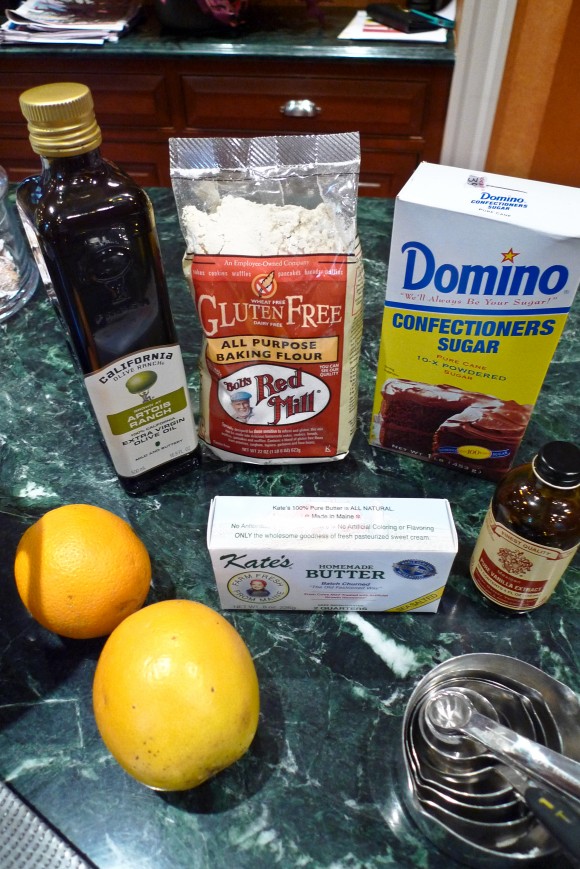
This week, I decided to make cookies. It was good timing because Bob’s Red Mill and California Olive Ranch had just offered to send me some of their products to bake with. And lord knows I love free baking ingredients. Since I use both of these companies’ products regularly, this was a no brainer.
There are so many delightful things you can bake with olive oil. My favorite flavor pairing is olive oil with citrus. There is something about the sweet citrus that stands up nicely to the sort of spicy, fruitiness of the oil. (This works well in salads, too.) And then you can take the combination a step further, and add almonds, or polenta.
One of my favorite cakes is a recipe from Claudia Roden, made with whole oranges, almonds and olive oil. I’ve love Gina DePalma’s Olive Oil and Polenta Cake, and am desperate to try Niahm Shields‘ recipe for ‘little polenta, almond, and blood orange cakes’ in her new book ‘Comfort and Spice‘.
But, this week, instead of a cake (that I’d likely consume in its entirety), I opted to boost my classic shortbread recipe, and play around with citrus, olive oil and polenta. And then do a second round, gluten free. These cookies remind me of Italy, and christmas, and happiness in winter.
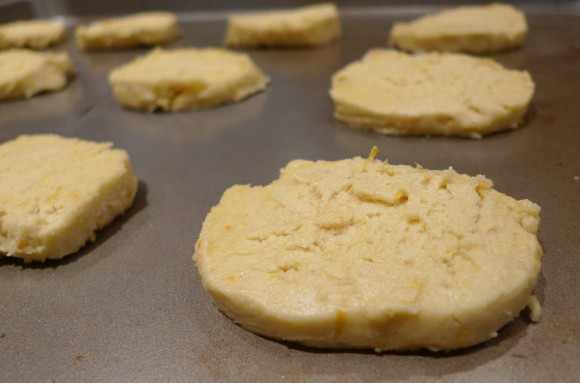
Orange Olive Oil Shortbread
Makes about 2 dozen
I actually made two separate batches of this cookie. The first I used 1 1/2 cups regular AP flour and 1/2 cup cornmeal (polenta) and it resulted in a satisfying crunchy cookie. The second go around I used 2 cups of Bob’s Gluten-Free All Purpose Baking Flour, and omitted the cornmeal. I wanted to see if I could do a good GF version, and was happy to find that it worked out well! The gluten free version was lighter and crispier, but both were pretty splendid.
About the olive oil – you can actually use a pretty robust olive oil, and you’ll get a nice grassy, fruity undertone. Or, if you’d like to tone the olive back a little bit, you can use a more mild and buttery oil. California Olive Ranch sent over the Artois Ranch, which was more mellow for baking, but I’ve also used their Everyday Extra Virgin with great success in cookies.
2 cups all purpose flour (or 1.5 cups + 1/2 cup cornmeal)
a pinch of kosher salt
1 stick unsalted butter, softened
1/2 cup olive oil
1/2 cup powdered sugar
1/2 teaspoon vanilla extract
zest of a small fragrant orange
1. In a bowl, mix flour, cornmeal (if using) and salt, and set aside.
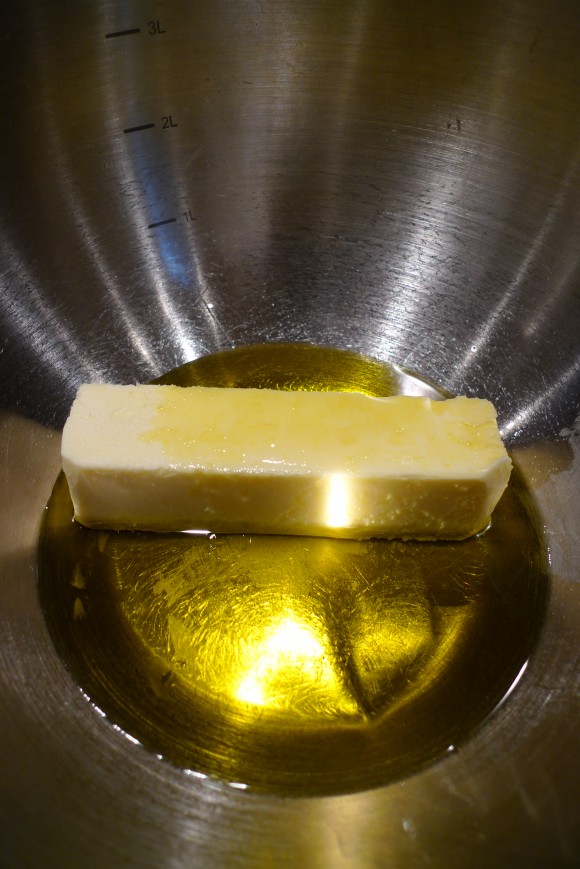
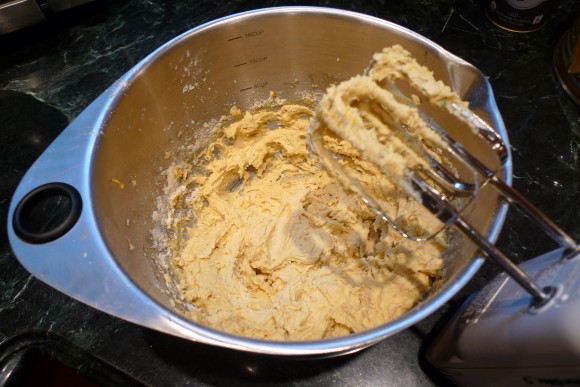
2. In the bowl of a mixer, add olive oil, softened butter and sugar, and beat on medium speed just until just smooth, about 2 minutes. Add vanilla extract, and orange zest, and beat until combined. Set speed of mixer to low. Slowly add flour mixture to the mixer, and beat on a low speed until blended and just coming together. This will be a moist and airy dough, but will firm up enough to cut when put in the freezer.
3. On a piece of parchment on top of a piece of tin foil, form dough into a log and roll up (like a burrito); freeze 1 hour (or up to a month). 10 minutes before taking the dough out of the freezer, preheat the oven to 350 degrees Fahrenheit.
4. Remove shortbread from the freezer and remove parchment. Slice logs into 1/4-inch-thick rounds, and space about 1 inch apart on baking sheets. Bake in the preheated oven until the edges are just slightly golden, about 12 minutes. Let cool to room temperature. (Cooling both allows the cookies to firm up so that they don’t fall apart, and will also help you to avoid burning your mouth on 350 degree butter.)
Cookies can be stored in an airtight container for up to 1 week, but believe me, they won’t last this long. They are also freezable, for up to a month. The bonus when you freeze them is that the butter in the cookie firms up slightly. They taste pretty fantastic frozen, if you ask me.
I received complimentary products from Bob’s Red Mill and California Olive Ranch, which were used in the creation of this recipe.
by Sam Tackeff | Oct 25, 2011 | Baking
Every morning I wake up and head to the kitchen to put the kettle on. I’m not sure when coffee became part of my morning routine – sometime after I graduated college and settled into my own first kitchen, perhaps – but it quickly became my favorite part of the day, a personal and quiet moment just for me.
I like coffee in the morning because it requires a little bit of careful attention to make a good cup, but nothing I can’t do while still groggy from my deep slumber. There are a bevy of contraptions to use – the coffee machine, the Mukka, the single dripper and filter, but lately I’ve been using my French Press. It makes more coffee than I need, but I get great satisfaction out of pushing down the plunger and separating the grinds from my magic liquid elixir.
There is also ritual in the type of drinking vessel and how you take your coffee. My mom drinks hers black, from the mugs she collects around the world from each city she visits. My dad likes his in the small grey San Francisco mug, with fat free half and half, and several packets of Splenda. I think he’d prefer cream and sugar, but he abstains. I have mugs for different moods: short, round and white with a curved handle, or brown with no handle and a rubber ring you can hold without burning your fingers. I take my coffee too, according to mood – sometimes black to taste the true flavor of the beans, more often with a splash of half and half, or on the days I feel like treating myself, mixed with heavy whipping cream.
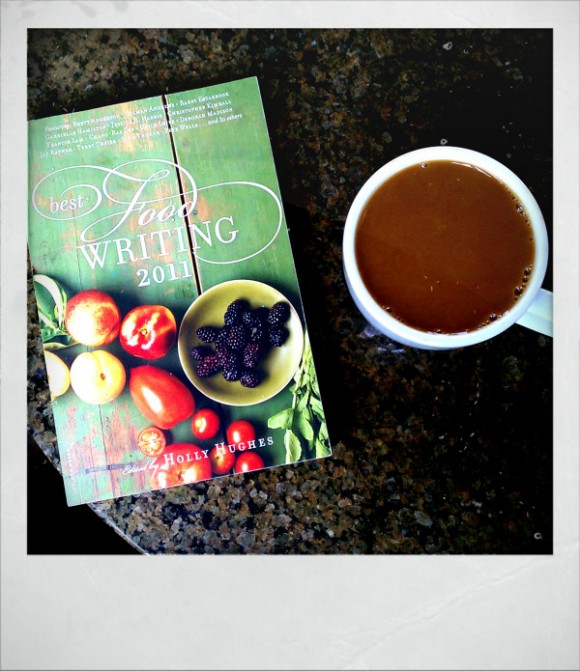
Once the coffee is done, I sit down with my mug and a book and begin my morning. Right now my wake-up literature is Best Food Writing 2011, thanks to the kind folks at Da Capo Press. I’ve been reading the collection backwards, and the first story I read, a short piece about Toast by Michael Procopio is in itself worth buying the book for.
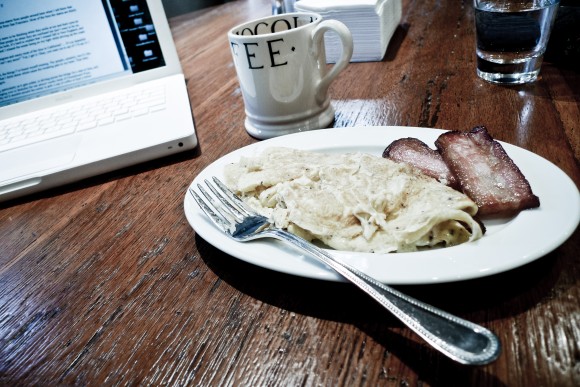
On weekends, I sit down with my coffee and some breakfast and my computer, and attempt to plan out my week in food. Usually I surround myself with cookbooks as well, and create lists of breakfasts, lunches and dinners and a few good kitchen projects to get me excited about life.
This week I decided that my kitchen adventure was going to include coffee. This is problematic because I am in a committed relationship with someone who does not like coffee in the least bit, and is happily content living a life without. The only exception he makes is for ice cream, and it has been seasonally cold this week, so I wasn’t too keen on that idea.
But, then, I thought – a trick! What if I put the coffee in pudding? Devon loves pudding in all forms! If I put the coffee in the pudding, he will not be able to resist it. He will eat it even if he doesn’t love the taste, but will be happy because it is pudding, that sweet and creamy manna from heaven! I’m well aware that this logic is selfish, and not very loving, (and will make him grumble when he reads this) but you should see his face when he has just made himself a box of Dr. Oetker’s butterscotch. And home made pudding is always better.
I found a good recipe (see below) and adapted it: my first go around was a chocolate coffee pudding with Kahlua whipped cream. Then I made a second batch, adapting it once more: having tweaked my pudding technique, I made a riff on Turkish coffee – a straight coffee pudding scented with heady cardamom pods.
Chocolate Coffee Pudding
makes 4 small cups
(or 3 if you manage to eat a full ½ cup while cooking…)
I noticed this recipe for Coffee Pudding on Not Without Salt about a year ago. I bookmarked it, hoping for some excuse to make a batch. Last week I got a package of Peet’s coffee in the mail from the Foodbuzz tastemaker program, and decided that this was as good a time as any. I adapted it for my taste – a punch of chocolate for my sweet tooth.
1 ½ cups heavy cream (or half and half, but the cream makes it tasty!)
½ cup strongly brewed coffee (or espresso)
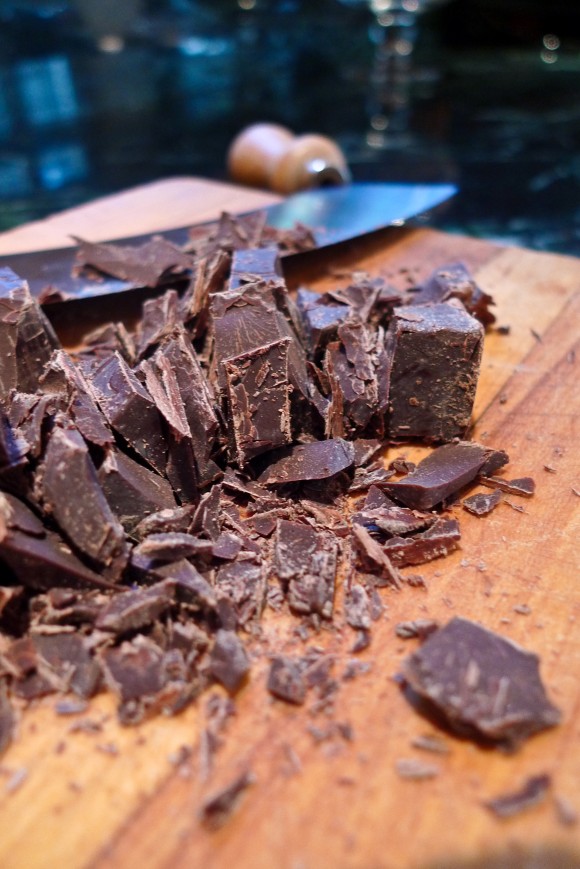
2 ounces really good quality semisweet or bittersweet chocolate, in pieces.
2 tablespoons cornstarch
2 tablespoons brown sugar
¼ teaspoon salt
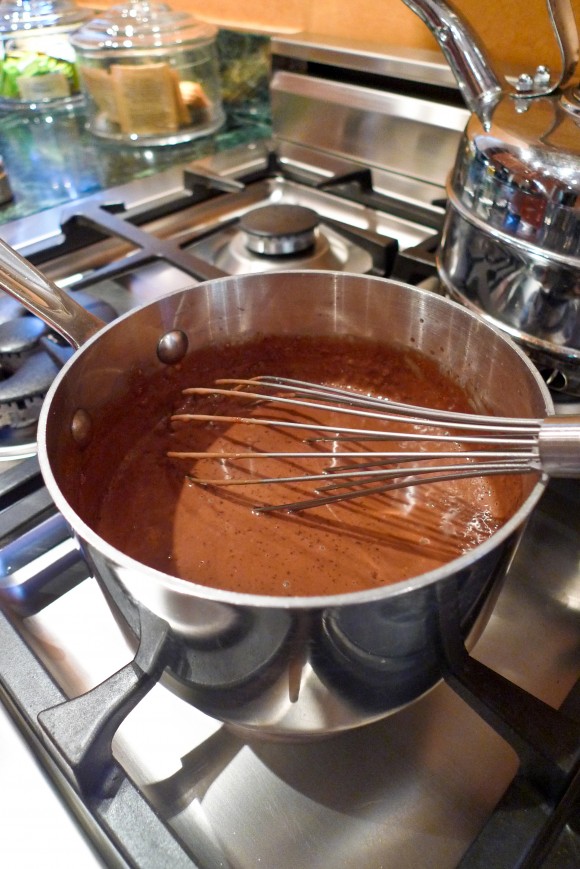
1. In a saucepan over medium heat, stir the cream and the coffee, and the chocolate together with a wooden spoon until it comes to a simmer.
2. In a small bowl, stir together the cornstarch, salt and sugar. Whisk to remove the lumps. (I find a mini-whisk is really useful for this purpose!)
3. As soon as the cream and coffee mixture comes to a simmer, take a few tablespoons of the creamy liquid and add it to the cornstarch mixture to create a slurry; whisk well to combine. Then dump the (now wet) cornstarch slurry back into the warm cream and coffee. Bring to a boil for 1 minute as to activate the cornstarch.
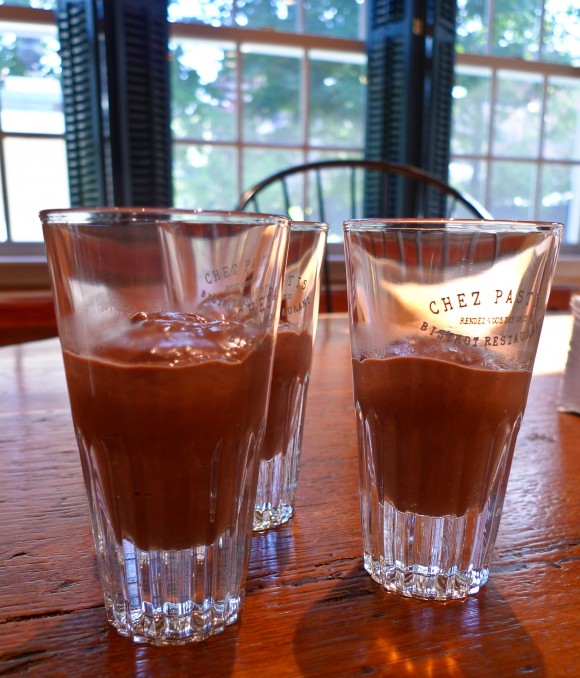
4. If you are intent on the smoothest pudding, pour the pudding through a fine strainer to remove any lumps (I’m usually too lazy to do this). Spoon into four small pudding dishes (or two large coffee cups, if you want to be cute and gluttonous at the same time.) You can cover the surface with plastic wrap if you don’t like skin forming, but I do, so I just cover the cups loosely. Refrigerate until set, at least three hours. Serve with sweetened whipped cream.
Whipped cream note: to make whipped cream, use heavy cream and a little bit of sugar. You can flavor it with a capful of vanilla extract, or in this case, a little rum or even Kahlua works marvelously.
Variation – Coffee Cardamom Pudding: omit the chocolate, and use ¼ cup brown sugar. In the first step, steep 3-5 cardamom pods in the warming cream and coffee. Remove the cardamom when it comes to a simmer, and follow the recipe the same way.
by Sam Tackeff | Aug 31, 2011 | Baking, Candy
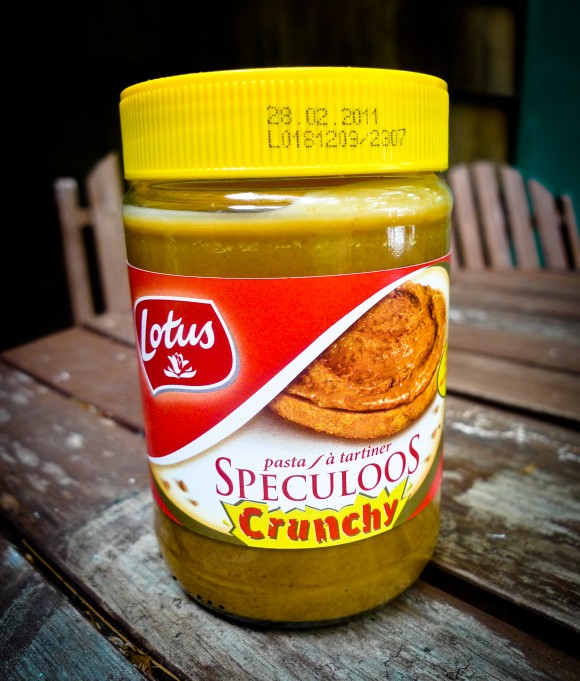
Here’s a public service announcement for you.
This product exists, and my brother smuggled it across the border from Canada. I started weeping.
That’s all for now. I have a date with the jar and a spoon.
by Sam Tackeff | Jun 19, 2011 | Baking
Monday was my last day at work… It happened a little suddenly (and secretively), because my office didn’t have a two-week notice policy; the day you choose to leave is your last. So I went to work, had a fabulous last hurrah and finished up some loose ends, spent the day with people that I really really like and am going to miss terribly, and then sent out my final email which included a picture of puppies.
Wait… why might you ask would I quit my awesome start-up job in San Francisco right when things are getting exciting? Well, to move back to New England! Essentially, we thought to ourselves – is this where we want to be in five years? Ten years? And the answer is, not really. Mostly because I want to be close to my family and friends, and also, a teeny tiny dwelling roughly the size of your mom’s garage (technical term there) will cost about 1.3 million dollars in our neighborhood. That wasn’t going to happen any time soon.
In about two weeks, we are selling most of our things, packing up the car and going on a road trip! The journey will take us to Reno, Salt Lake City, Denver, Omaha, Chicago, lunch stop in Ann Arbor for some Zingermans, Cleveland, Syracuse, and then finally the ‘Shire, until we can get our act together and move to Boston. I’m going to need plenty of good recommendations for road food in these cities.
Among the master list of things to do before an outrageous move, I’ve spent the past couple of weeks making a concerted effort to clean out my freezer. First, I took everything out and created a long list of the contents. Aside from the usual freezer items, I had some very special items I’ve been saving up (aka hoarding) and now I get to actually eat! The Skillet Bacon Jam that Seattle Tall Poppy brought me was particularly exciting, as was the chocolate babka made by Michael Kalanty (author of How to Bake Bread), and perhaps best of all – a bag of tart and sweet wild huckleberries that was foraged by the legendary Connie Green (author of The Wild Table). Who for the record looks exactly like Meryl Streep.
I decided to do something special with these huckleberries – a huckleberry buckle! (Okay, mostly because it is fun to say). While searching yesterday for suitable/off-beat information about huckleberries on the internet I found this: apparently Stone Temple Pilots have a song on their new album called “Huckleberry Crumble”. The song has nothing to do with baking, and as far as I can tell may be about a bad relationship and has some offhand references to Alice in Wonderland.
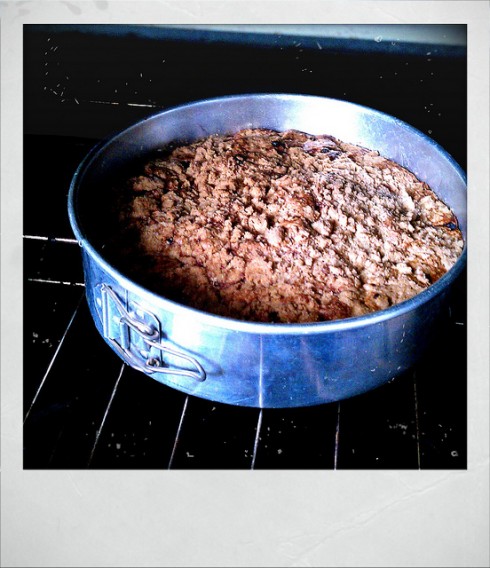
I had saved this particular recipe from Saveur a few issues back that I had been meaning to try with blueberries (until I remembered that I had a whole bag of huckleberries in my freezer). The cake is moist, crumbly and sweet – suitable for afternoon tea, dessert, or even breakfast.
Huckleberry Buckle
(Adapted from Saveur Issue #122)
This could be easily made with fresh or frozen blueberries, but huckleberries are a particular treat if you can find them. Also, this actually great as it sits, so you could definitely make this a few days in advance of a barbecue or picnic, and you’d be the party pleaser.
8 tbsp. unsalted butter,
softened, plus more for pan
6 tbsp. plus 1 3/4 cups flour,
plus more for pan
1 1/2 cups sugar
3/4 tsp. kosher salt
3/4 tsp. ground cinnamon
1/8 tsp. freshly grated nutmeg
2 tsp. baking powder
2 tsp. vanilla extract
1 egg
1/2 cup milk
1 lb. huckleberries or blueberries
1. Set the oven to 350˚. Butter and flour a 9″ (or in my case, 10″) springform cake pan and set aside. For the topping, put 4 tbsp. butter, 6 tbsp. flour, 1/2 cup sugar, 1/4 tsp. salt, cinnamon, and nutmeg together, and squidge with your fingers until the mixture comes together into small clumps. This is possibly the most satisfying step of the recipe, so have fun here.
2. In the bowl of a KitchenAid mixer, beat the remaining butter and sugar on medium speed until pale and fluffy, about 1 minute. Add vanilla and egg and beat until smooth. Add the flour, salt, baking powder and stir to mix. Add the milk and mix for 1 minute. Add the huckleberries and, using a rubber spatula, fold them gently into the batter. If you do this aggressively you batter will turn bright purple, so gently is the key!
3. Spoon the batter into prepared pan, gently spreading to an even layer, and sprinkle with crumbly topping. Bake until a toothpick inserted into center of cake comes out clean, about 1 1/2 hours. Let cool before serving. Spoon into bowls and top with softly whipped cream, or vanilla ice cream (or, if you feel like being slightly uncouth – just pour on some half and half) .
by Sam Tackeff | Jan 29, 2011 | Baking, Challenge, Cookies, omnivore books
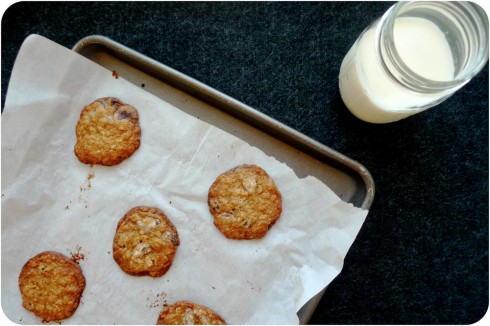
Hint To Self #324: If you are hosting a cookie competition, there is no way in hell that you will not eat dozens of delicious cookies. Your plan of 3-5 cookie samples is an outrageous underestimation of the truth, and a lie to yourself. You’ve learned this at countless previous competitions. Plan accordingly.
But, before I re-cap the hardcore competition (yeehaw!), I want to take a quick moment of reflection. Today, a reader who shall go nameless, actually apologized for commenting so often on my blog, and let me know that she hoped I didn’t think she was crazy. This actually made me a little sad, because it couldn’t be farther from the truth. I can’t thank you all enough for coming and reading my blog. The reality is, every time I read a comment, my heart fills with joy. And yes, that even goes for my mom, who I know has been reading every single post dutifully since the beginning.
My first attempts at blogging as a teenager were a personal pursuit. Nobody actually read my LiveJournal, and I was okay with that. I started writing this blog though because I missed my family, my home, my community, and food. It was a scattered attempt to find my place in this world, to share my experiences and to exist within a community of like-minded folks that I so admire. Over the past few years, it has been truly miraculous to meet so many wonderful people because of this blog, and while working at Omnivore Books. You’ve all made my life so much greater for it, and again, I thank you.
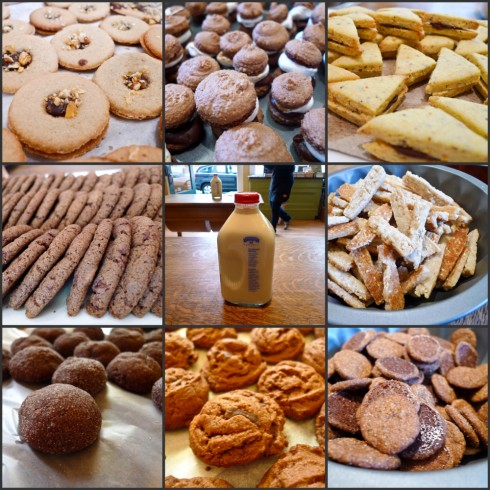
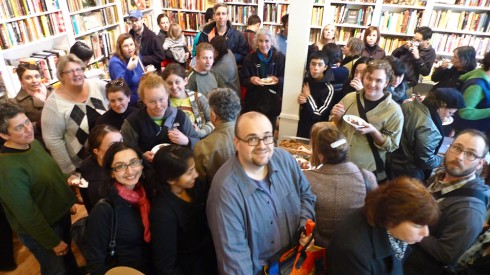
Off my sentimental soapbox for a bit, it’s time for another competition round-up from our little corner of the world at Omnivore Books on Food! We’ve had pies, fried chicken, pumpkin recipes, tomato recipes to name a few. This time, with cookies, I think we truly took it to another level.
Now, if you know me personally, you know my love for cookies runs deep. I can tell you that it is exactly an 11 minute walk to Anthony’s Cookies from Omnivore Books. When I test a new cookbook, if they have an oatmeal chocolate chip recipe, you can be sure that I’ll make it. (Mad Hungry is in the lead – see the top cookie shot there). If you are ever in the area near Brown University, you need to make a pit stop for a Meeting Street cookie, which a friend of mine once admitted that if she could, she would pro-create with one. Her grandmother, incidentally, makes a peanut butter cookie that rivals all others. And if you are ever able to make it to Big Sur Bakery, Michelle’s chocolate chocolate chocolate cookies are glorious, as are all of the varieties.
I share this all with you, because, being cookie obsessed I hold very high standards, and today I was very impressed. There was a real breadth of entries in this competition. I’m missing about five here, because in the end we sort of just exploded with cookies.
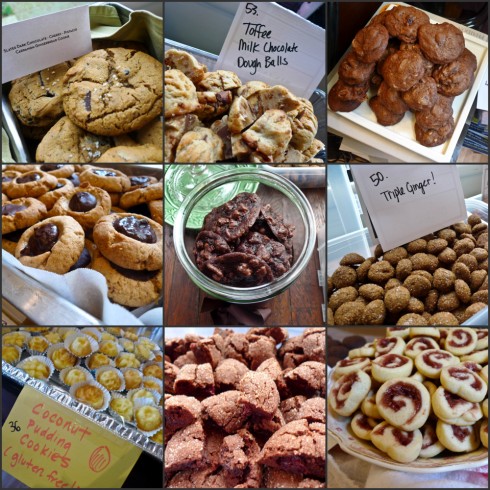
In no particular order:
Brown Sugar Toffee, Chocolate Chip, Chewy Almond Raspberry, Jacques Torres Spiced Chocolate Sugar Cookies, Orange Polenta, Chai White Chocolate Shortbread, Macadamia White Chocolate Chip, Caramel Cashew Choc-Oat-Ban, Toasted Walnut, Crispy Spicy Gingerbread Coins, S’more Macarons, Mayan Mexican Chocolate, Crispy Sesame Sticks, Chocolate Peanut Butter Sandwiches, Sugar Babies, Coconut Bars, Chocolate No-Bake Cookies, Chocolate Peanut Butter Fudge-gasms, Double Chocolate Mint, Cranberry Orange Pecan Oat, Coconut Pudding (gluten free!), Mocha Shortbread Chocolate, Salted Caramel Whoopie, Pecan Thumbprints, Raspberry Coconut Swirls, Mocha Squares, Chocolate Pecan Cherry, Mexican Hot Chocolate, Chewy Quinoa Raisin, Lemon Ricotta, Uncle Bill’s Cookies, Chocolate Spiced Cherry, Chocolate Chocolate, Double Chocolate Cherry Toffee, Chocolate Espresso, Triple Ginger, Lavender Shortbread, Salted Peanut Butter Triple Chocolate, Salted Chocolate Cherry Pistachio Cardamom, Toffee Milk Chocolate Dough Balls, Lemon Rosemary, Almond Butter, Cowboy Cookies, Oatmeal Chocolate Chip, Monster Cookies, Peanut Butter Chocolate Chip, Perfect Chocolate Chip, Sable with Black Tea and Plum Jam, and Chocolate Toffee with Sea Salt.
I was happy to see so many people I know, and meet lots of new folks as well. (A quick shout out here to Irvin whose wonderful blog Eat The Love just got a nod from Saveur because he is a rockstar!!! And, because I met her for the first time last week, one to Annie the Baker, whose dough balls are the stuff of legend.)
The second place winner – who in my post-sugar-coma I neglected to write down her name – won for her Salted Peanut Butter Triple Chocolate Cookies. As I started tallying the votes, I realized that I hadn’t tried one of these yet, and they were heading clearly to the lead. I’m glad that I snagged one before they were all gone! For her success, she won a coveted year long membership to The Bakers Dozen.
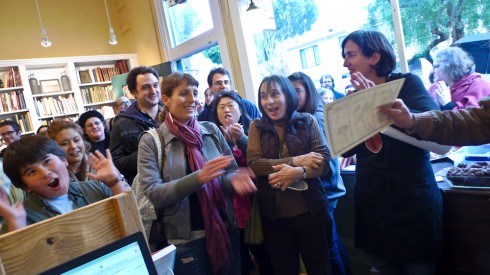
The winner, Julie Wise, won $150, with her Chocolate Toffee Cookies with Sea Salt. She entered the contest at the urging of her son, and is donating the winnings to his school, Mira Loma! So, pretty much, she also deserves an award in the coolest mom category.
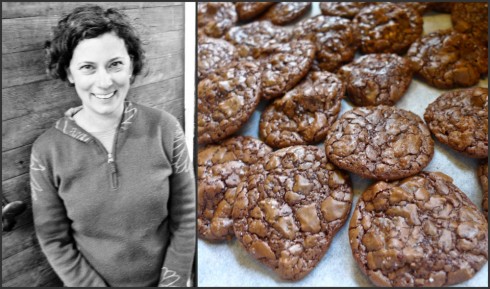
Here is the winning recipe! Now I’m headed to sleep off the sugar coma. Celia, I believe, is a better woman than I, and last I checked twitter is heading to IN-N-OUT. That is dedication people. Have a great rest of the weekend everyone!
Chocolate Toffee Cookies
Adapted from Smitten Kitchen, where it was adapted from Bon Appetit
* * *
1/2 cup all purpose flour
1 teaspoon baking powder
1/2 teaspoon salt
1 pound bittersweet or semisweet chocolate, chopped
1/4 cup (1/2 stick) unsalted butter
1 3/4 cups (packed) brown sugar
4 large eggs
1 tablespoon vanilla extract
5 1.4-ounce chocolate-covered English toffee bars (such as Heath), coarsely chopped
1 cup walnuts, toasted, chopped
Flaky sea salt for sprinkling (optional)
Combine flour, baking powder and salt in small bowl; whisk to blend. Stir chocolate and butter in top of double boiler set over simmering water until melted and smooth. Remove from over water. Cool mixture to lukewarm.
Using electric mixer, beat sugar and eggs in bowl until thick, about 5 minutes. Beat in chocolate mixture and vanilla.
Stir in flour mixture, then toffee and nuts. Chill batter until firm, about 45 minutes.
Preheat oven to 350°F. Line 2 large baking sheets with parchment or waxed paper. Drop batter by spoonfuls onto sheets, spacing two inches apart. Sprinkle with a pinch of flaky sea salt, if you’re using it. Bake just until tops are dry and cracked but cookies are still soft to touch, about 10 to 13 minutes. Cool on sheets. (Can be made 2 days ahead. Store airtight at room temperature.)
by Sam Tackeff | Dec 11, 2010 | Baking, Books, Chocolate, Cookies

There are some cookbooks I read at the shop and fall madly in love with, but refuse to take home until I can no longer resist them because I know that I’m doomed when I do. Doomed! [Don’t worry, they win out at the end, I assure you.] Alice Medrich’s ‘Chewy Gooey Crispy Crunchy Melt-In-Your-Mouth Cookies‘ is one of those books.
This is because if there is any problem worse than my “cook-book problem”, it is my “cook-ie problem”. I am the type of person who will eat an entire batch of cookies if proper safeguarding precautions are not taken. And, as I’ve been giving in a little too often to my cookie problem, the one pair of jeans that I can still fit into are threatening to burst. I’m holding out as long as I can, damn it.
Alice came to Omnivore to talk about the book, and after spending a whole hour with the Goddess of Chocolate, it has taken every effort of mine not to bring it home and immediately start baking. My resolve was even further weakened by actually eating cookies made from the book:
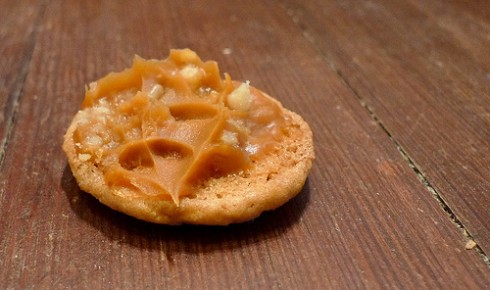
For the talk, Celia made her Alfajores, a sweet and slightly crispy Latin American cookie filled generously with dulce de leche. Crispy and Gooey? Yes, please! She tweaked the recipe slightly to add some nuts and a little bit of extra salt. I had four, and would have had more had my mother not ingrained the principle of sharing. This was difficult. Had I been only a *slightly more selfish* and greedy person, there would have been none left in minutes.
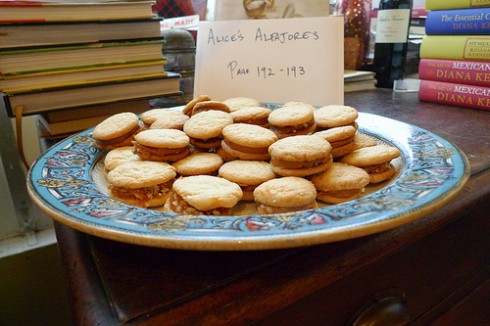
A few reasons why you need this book:
1. It’s by Alice Medrich. **(see below)
2. The broad organization. The book is a play on textures and flavors. You get to choose from Crispy, Crunchy, Chunky, Chewy, Gooey, Flaky, and Melt in your mouth. Alice Medrich is a “crispy” girl. I’m a “chunky” girl myself. Yes, I said that. The more chocolate hunks or nuts, the better.
3. It’s all in the details. “Cookies seem deceptively simple. But success with cookies is success in the details,” Alice noted. When you give the same recipe to ten cookie bakers, even experienced ones, you might just come out with ten completely different versions.
This book seeks to streamline your baking. If you can conquer at least some of the variables, you will make better cookies. A user’s guide, quick start, FAQ’s, ingredients, equipment, are all there to make cooking baking more precise and successful.
The quick start gives the five most important details about successful cooking baking: amounts of flour, types of flour, oven temperatures, preheating the oven, and types of baking sheets. The FAQ’s go into even more detail about basic ideas: how to toast nuts, why you would chill cookie dough, what the best way to flatten dough, etc.
And yes, Alice Medrich wants you to get a scale. (And so do I. I got mine at Ikea for 12 dollars. What are you waiting for?) The measurements in the book are also in cups, but using a scale will give you great, consistent results.
4. The “Smart Search”. Even better than just an index, there is a brilliant section called the “smart search”. Need Wheat-free cookies? She lists the 40 or so options for you. Whole-Grains? Dairy-free? Ditto. Ridiculously Quick and Easy? Same. Don’t have time to bake during the holiday season? Well, there’s a whole list of ‘Doughs that Freeze Well’ and ‘Cookies that Keep At Least 2 Weeks’. Yes, there are even low-fat. Although, I’ve become wise to understand that low-fat doesn’t in any way mean that you should eat the whole batch.
5. Simplicity. After 8 cookbooks, things are getting more do-able for the home-cook. That doesn’t mean that she skimped on the fun stuff. “Anything I do, I need to learn something, and I need to teach something,” Medrich says. There are classics, and new twists on old favorites. “I didn’t want it to be something that an ordinary home baker with kids wouldn’t want to pick up and bake from”.
6. Well tested recipes. If you are familiar with any of her older cookbooks, including her IACP winning book ‘BitterSweet‘ you know first hand that her recipes work. When she wrote her first cookbook, she did a huge series of ‘Side-by-Side’ testing in a kitchen with a friend to compare how they interpreted the written recipes, and tweak to get more consistent results. (A fairly genius idea.)
Medrich also teaches cooking classes. “The teaching helps, because I do the recipes and get to see what questions come up.” Teaching is also useful to help a recipe writer guide the reader in the recipes. Learning how people interpret words on the page teaches her to be a better writer and learn to use more specific explanations. And the difficult part of testing? “First, too much tasting, and second, knowing when to stop.”
7. Well written recipes. Often, recipes take for granted things that are intuitive if you’ve had a lot of practice in the kitchen, and the author forgets to write down steps that the novice might not yet know. When you read through any of Alice Medrich’s recipes, it’s like you have a perceptive friend guiding you through things, so you don’t forget the basics while under fire.
It was rumored that Julia Child once said to Flo Braker “Write what works for you, Dearie”, and Medrich re-emphasizes that. “The good writers are the ones who ignore how it’s always been done and explain it in a way that makes sense to them.”
8. The personal touch. Alice has been on the set since book one cooking and styling her own dishes for the photo shoots. (For those less familiar with cookbook production, this is rarely the case). “It’s the thrilling part of the process in this book!” she said.
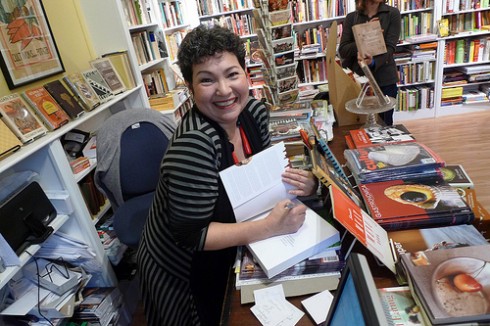
** While it’s important to focus on the merits of the cookbook itself, I take great pleasure in knowing the history of cookbook authors. It sweetens the deal when you get to use a book written by an inspirational (and smiling!) woman like Alice Medrich.
The Backstory:
When Alice Medrich was twenty, she went to Paris. It was there that Mme. Estelle, her land-lady, taught her about the Truffle, “that smooth, bittersweet statement about chocolate” that unbeknownst to her, would lead her to great things.
Upon coming back to Berkeley, her future still unclear, she opted for the rational lifestyle choice of putting off the real world… and heading to business school. Given that I almost went to business school right after graduating college, I can understand the impulse. (Though I’m glad I didn’t.)
At business school, she spent her free time making cocoa dusted chocolate truffles for the new Pig-By-The-Tail, Victoria Wise’s charcuterie shop. It didn’t take long to realize that she was becoming more interested in creating a dessert repertoire than dealing with case studies, and soon dropped out of b-school.
Before opening a pastry shop, Medrich did her due diligence. She headed back to Paris to take classes at Lenôtre, the famed pastry school, where she was often the only woman in her pastry classes.
She learned timing, temperature, and the physicality of multiplying recipes by trial-by-fire: at Pig-By-The-Tail, she would come up with a weekly special at the beginning of the week, an elaborate pastry that could be pre-ordered by six lucky customers. Without actually knowing if it would work, Medrich set about learning the recipes as she went – theoretically she would get enough practice by the end of the week to make at least six!
In 1976, she opened her shop, ‘Cocolat’.
I’ve heard more than one Bay Area native wax poetic about Cocolat and moan desperately about Alice’s legendary truffles. Celia (@omnivorebooks) used to head to the shop with cash from her co-workers in each pocket to pick up a bounty on her breaks. Mary (@mcs3000) recalled saving money to buy Alice’s first cookbook and making her Strawberry Carrousel Cake.
As a newcomer to San Francisco, it’s stories about shops like Cocolat that make me regret having not grown up here. By the time I moved here, Cocolat was no longer. (Pig-By-The-Tail, and Fran Gage’s Pâtisserie Française are others that I tragically missed out on.) I can’t live my life dwelling upon the fact that I’ve lived in the wrong era, but stories about the truffles and Cocolat’s ‘Reine de Saba’ make it hard not to. Another good reason for cookbooks like ‘Chewy Gooey” to help keep a legacy alive!
Alice’s Quick Bites:
That’s a lot of chocolate! In the early days, it wasn’t so easy to find quality ingredients. She used to send friends and family to purchase all the Ghiradelli Semisweet chocolate from the supermarkets (the best you could find at the time), until she realized that she used enough to get wholesale. Soon, Fifty pounds of chocolate wasn’t enough, and by the time she opened Cocolat, she was getting 300, even 500 pounds a month of chocolate delivered to her door!
Her favorite baking chocolates? “The most important thing is to use what you like the taste of. I still use Scharfenberger, because I like the taste a lot,” Alice says. (While I love using Valrhona myself, for chocolate chips I use Ghiradelli 60% cacao, which are flatter discs because of a higher fat content.)
Who eats all the recipes she tests? Her neighbors have been next door from her for more than thirty years, and they don’t accept treats anymore. (She fondly remembers the day that they sat down and ate an entire cake together.) Nowadays she gives them to whoever will take them – the new neighbors on the block, the synagogue down the street, a friend’s softball team.
On Inspiration: Inspiration comes from everywhere. Sometimes easily: “A lot of new recipes come from a recipe that is good already rather than a recipe you want to fix.” Other times, more abstractly: “I once developed a recipe from a salad from one of Paula Wolfert’s cookbooks.”
Her next project: Already in the works, a baking book for people more comfortable with cooking than with baking. Recipes that work the way cooks work, with a little bit more flexibility.
Chewy Gooey Crispy Crunchy Melt-in-Your-Mouth Cookies
by Alice Medrich
384 pages
Artisan Books
http://alicemedrich.blogspot.com/